by Sol Nasisi
Share
by Sol Nasisi
Chainletter Perpetual Credentials and W3C Credentials
As more credential vendors promote their platforms as “W3C credentials,” institutions should slow down and ask a better question: does standards compliance by itself solve the real problems registrars face?
The W3C Verifiable Credentials Data Model is important. It defines a machine-verifiable credential model and describes an ecosystem built around issuers, holders, and verifiers. Open Badges 3.0 also aligns with the W3C VC model and is designed to support packaging credentials into broader learner records and verifiable presentations. (W3C)
That is meaningful progress. But it is not the same thing as giving an institution a durable, low-friction, future-ready credential strategy.
Chainletter makes a stronger case for six reasons.
1. Standards compliance is not the same as long-term durability
A vendor can claim W3C support and still leave an institution dependent on centralized infrastructure. In many real-world implementations, the credential may be standards-aligned, but verification still depends on a vendor portal, hosted webpage, or proprietary workflow.
That is the weakness institutions should care about. A credential is only as durable as the trust model behind it. If verification ultimately points back to one company’s system, the institution is still exposed to the same old risks: vendor lock-in, product changes, link rot, acquisitions, or platform shutdowns.
Chainletter’s advantage is that it focuses on decentralizing trust, not just formatting credentials in a standards-compatible way.
2. Wallet-centered ecosystems still create friction
The W3C VC model is built around issuers, holders, and verifiers, and related W3C and 1EdTech materials describe exchange patterns that rely on holder-controlled credentials, presentations, and wallet-style workflows. Open Badges 3.0 also emphasizes alignment with the VC ecosystem and sharing between wallets. (W3C)
That may be elegant from a standards perspective, but many institutions are not eager to depend on widespread wallet adoption by graduates, employers, and administrators. The problem is not the idea. The problem is the friction.
A model can be technically sophisticated and still fail to gain practical traction if ordinary users have to change their behavior too much. Chainletter is W3C compatible, but it does not require institutions to treat wallet adoption as the prerequisite for trust.
3. Chainletter is not an either-or alternative to W3C credentials
This is where the conversation usually gets sloppy.
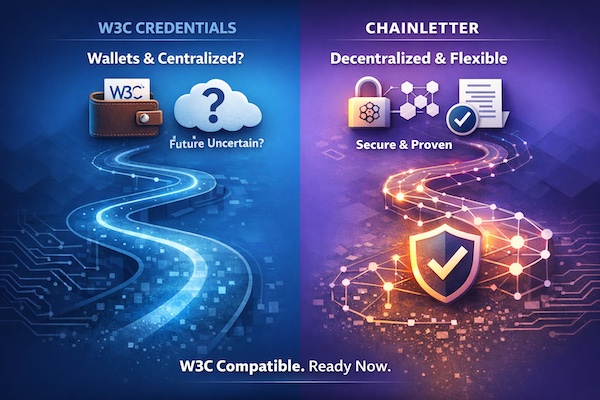
The choice is not “W3C or Chainletter.” Chainletter’s Perpetual Credentials are W3C compatible. They can stand alone as a decentralized credential system, and can also wrap an existing W3C JSON credential to add decentralized verification and durability.
That gives institutions more flexibility. A university does not have to abandon current credential workflows just to strengthen trust. It can continue using familiar systems while adding a decentralized layer that reduces dependence on centralized verification.
That is a much stronger institutional story than a rip-and-replace pitch. Universities do not move cleanly or quickly. Any solution that demands total replacement on day one is already a weaker solution.
4. AI raises the bar for what verification must mean
Generative AI is making it easier to imitate institutional documents, copy design systems, and produce convincing fraudulent credentials. At the same time, the W3C VC framework was designed to support cryptographically secured, machine-verifiable credentials. (W3C)
That is exactly why the market is shifting.
The old model of trust, where a person looks at a PDF or clicks a hosted badge page, is becoming less reliable. Credentials increasingly need machine-readable proof of integrity and provenance. They must be ready for automated validation by software platforms and AI agents, not just human reviewers.
Chainletter is stronger here because it is built around cryptographic verification and decentralized trust, which is better aligned with an environment where fake-looking-real is getting cheap.
5. The best standalone solution is the one that also complements other systems
Many vendors want to own the whole workflow. That sounds attractive in a demo and becomes a problem later.
The stronger solution is the one that can operate in two modes. Chainletter’s Perpetual Credentials can be used as a standalone decentralized credential system, but it can also complement another platform by wrapping credentials that already exist. That makes it useful for institutions at very different stages of digital maturity.
This matters because the real world is messy. Registrars have legacy systems, political constraints, procurement limits, and staff bandwidth issues. A solution that works independently and also strengthens existing infrastructure is simply more practical than one that only works if everything is rebuilt around it.
6. Institutions need market readiness, not just theoretical alignment
This is the point that gets missed most often.
The W3C ecosystem is real, and it is still evolving. W3C published VC Data Model 2.0 in 2025, and VC Data Model 2.1 was published as a First Public Working Draft in April 2026. W3C’s own charter for the current work points to expected completion in 2027. Meanwhile, 1EdTech continues to position Open Badges 3.0 and related credential standards as part of a broader interoperable ecosystem. (W3C)
That tells you something important: the standards world is advancing, but the market is not settled.
Institutions do not buy infrastructure based on where standards may mature eventually. They buy based on what works now at manageable friction and acceptable risk. There is still no clear marketwide timeline for when wallet-centered W3C credential workflows will feel normal across higher education. That does not make the standards bad. It means institutions should not confuse theoretical alignment with operational readiness. (W3C)
This is where Chainletter has the stronger practical story. It is ready now as a cryptographically secure, decentralized credential approach. It is also W3C compatible, so an institution can stay aligned with standards while solving the immediate problem of durable, decentralized verification.
Chainletter does not force institutions to choose between present-day usability and future-facing interoperability. It gives them both.