by Sol Nasisi
Share
by Sol Nasisi
Over the past decade, higher education has made significant progress in digital credentialing. Universities are increasingly issuing and distributing credentials faster, more securely, and at greater scale than ever before.
But as digital credentialing matures, a new challenge is emerging, one that is less about delivery and more about durability.
Universities are long-lived institutions operating on short technology cycles. Degrees, certificates, and academic records must remain trustworthy for decades, often centuries. Yet most digital credential systems are designed around platforms, vendors, and databases whose lifespans are measured in years.
This creates an uncomfortable question institutions are only beginning to confront:
How do we ensure digital credentials remain verifiable and trustworthy if today’s systems are no longer available tomorrow?
Verification Today vs. Trust Forever
Most digital credential platforms answer an important operational question: Can this credential be verified right now? They do this well, and institutions rely on them appropriately for distribution, access, and convenience.
But long-term trust requires answering a different question:
Can the institution independently prove that a credential was issued, unchanged, at a specific point in time, regardless of what vendors, systems, or technologies exist in the future?
In many cases, the answer today is unclear.
If verification depends entirely on a single platform, database, or proprietary system, institutions are implicitly assuming that system will remain accessible, affordable, and intact indefinitely. History suggests otherwise.
The Risk of Vendor Dependency
Technology vendors merge, pivot, sunset products, or exit markets. The average life of a Fortune 500 company is 15 years. For smaller, technology oriented companies the lifespan is even shorter. That doesn’t even factor in changes in strategy or product mix that might disrupt the credential technology. APIs change. Platforms evolve in ways institutions cannot fully control.
None of this reflects bad intent, it is simply how technology ecosystems behave.
For registrars and university administrators, however, this creates risk. Credentials are not software features; they are institutional assertions of academic achievement. When verification relies solely on external systems, institutions lose independent control over proof.
A Trust Layer, Not a Replacement
Chainletter was built to address this specific gap. Chainletter acts as an independent trust layer that allows institutions to permanently seal cryptographic proof of a credential’s existence, integrity, and issuance date. That proof is anchored in a decentralized, tamper-resistant ledger (a blockchain) and does not depend on Chainletter, or any other vendor, being online in the future.
In practical terms, this means:
- Credentials can be issued and distributed today using existing workflows
- Verification workflows remain unchanged for day-to-day use
- Institutions retain independent, vendor-agnostic proof of authenticity into the future
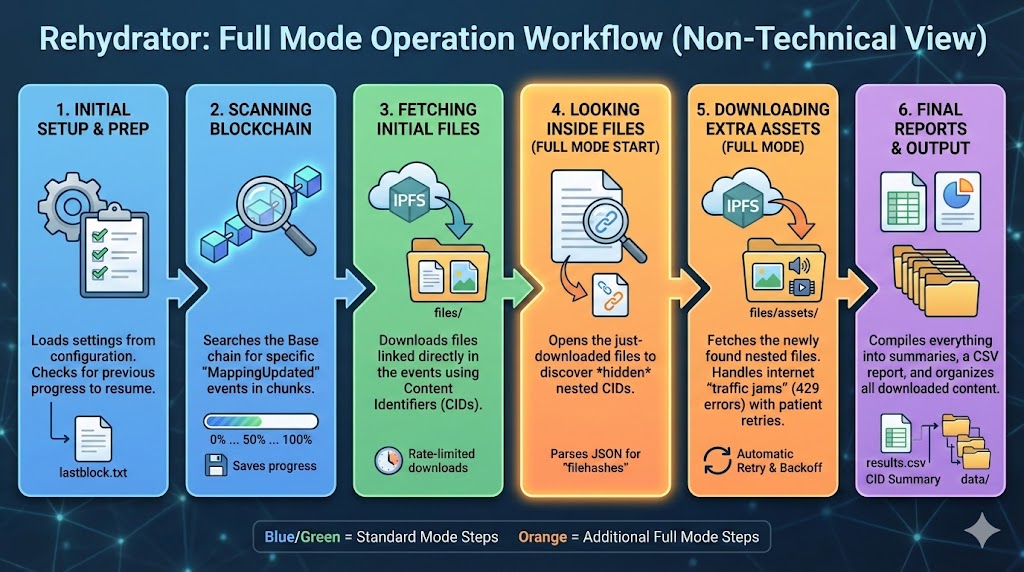
If a verification platform ceases operation decades from now, the institution can still demonstrate that a credential was issued, unchanged, at a specific moment in time. To ensure this, Chainletter has developed a dehydrator application allowing anyone to verify their records independent of the company.
Where Institutions Typically Start
Most institutions begin by applying permanent trust layers to credentials that sit outside traditional diploma and transcript workflows:
- Certificates
- Badges
- Continuing and executive education
- Non-degree programs
These credentials are often the fastest growing and the least protected from a long-term verification standpoint. Institutions may lack a platform for quickly and easily creating and distributing them. Adopting a distributed system like Chainletter has several benefits. As discussed, the credential platform is future-proofed against vendor issues. Second, the blockchain architecture often means that the solution is less expensive than proprietary databases that need to be backed-up, secured, and maintained.
Thinking Beyond the Current Technology Cycle
The most important credentialing decisions registrars make are often invisible. They are the ones that prevent future uncertainty, disputes, or loss of trust.
As institutions look ahead, registrars can choose a digital credential path that is not only less expensive, more secure, and more private today, but also designed to endure for tomorrow.